

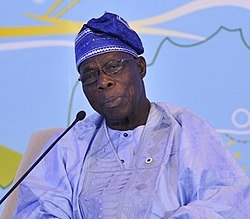
Former President Olusegun Obasanjo has once again stated that he does not know his exact age, explaining that his best estimate is based on the ages of his surviving primary and secondary school classmates, all of whom are now above 90.
Obasanjo made this known on Sunday, Dec. 7, during the Toyin Falola Interviews series themed “A Conversation with His Excellency, Chief Olusegun Obasanjo.” The discussion was hosted by Nigerian historian Professor Toyin Falola, alongside Bishop of Sokoto Diocese, Dr. Mathew Kukah, and former presidential candidate Professor Kingsley Moghalu.
The former Nigerian leader noted that although he has preserved extensive educational and personal records in his presidential library, none of them provides a definite answer about his birth year.
He said, “I don’t know my exact age but I could judge from those who were in school with me. I have given you an example of Olubara (Oba Jacob Olufemi Omolade, the Olubara of Ibara) who is still alive. I believe there are six of my classmates in secondary school that I know are still alive and none of them is less than 90 years of age. So I leave it to you to guess what my age could be.”
On the Purpose of His Presidential Library
Obasanjo highlighted that he established the presidential library to preserve Nigeria’s institutional memory and safeguard historical records for future generations.
According to him, “We have digitalised over 3m materials. We still have about the same number, 3m, to digitalise. The idea is when these materials are digitalised, people can have access to them. That is number one. As document preservation, we preserve the past, take note of the present, and we want all these to inspire the future.”
He explained that the library houses a wide range of documents, including:
-
His primary and secondary school records
-
A letter to former Head of State Sani Abacha after his son died in an accident
-
A letter to his wife written during his time in prison
-
Manuscripts of books he authored, including those written while incarcerated
-
Samples of crops of maize he planted while in prison
Obasanjo emphasised that record-keeping remains a major challenge in Nigeria, stating, “One of the things we don’t do too well in our society is that we don’t keep records very well; institutional memory is not what we do very well.”