




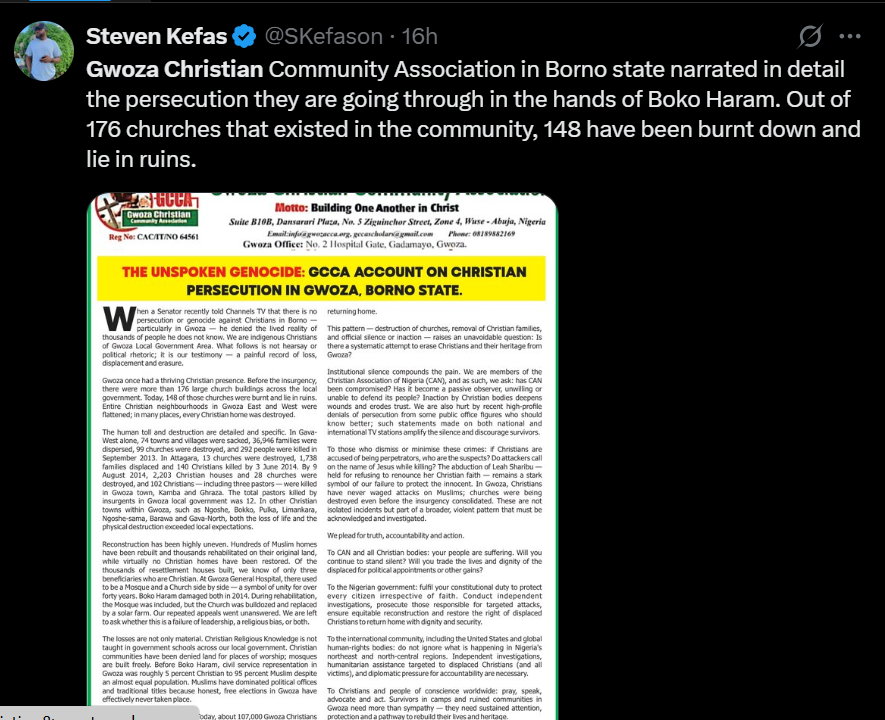
The Gwoza Christian Community Association (GCCA) in Borno State has revealed harrowing new details of Christian persecution in the town of Gwoza and its environs, stating that out of 176 church buildings in the community, 148 have been burnt down and now lie in ruins by the hands of the Boko Haram insurgents.
A Community Ravaged: Destruction, Displacement, and Loss
In a detailed confessional statement titled “The Unspoken Genocide: GCCA Account on Christian Persecution in Gwoza, Borno State”, signed by Rev Dr (Arc) Ayuba John Bassa (GCCA National Coordinator) and Rev Filibus K. Goma (Former EYN President and Chairman of the Board of Trustees), the group recounts years of devastation, displacement and loss of Christian heritage.
The statement says that before the insurgency, Gwoza had a “thriving Christian presence,” but now “entire neighbourhoods in Gwoza East and West [are] flattened and every Christian home destroyed.”
They reported:
-
74 towns and villages sacked, 36,946 families dispersed.
-
In one 2013 attack on Gwoza West alone, 292 people were killed.
-
In Attagara, 13 churches destroyed and 1,738 families displaced.
-
By June 2014, across Gwoza, Kamba and Gharza, 2,403 Christian homes and 28 churches had been razed, with twelve pastors among the victims.
What the GCCA Calls a Systematic Erasure
The association described the wave of attacks as part of a “systematic attempt to erase Christians and their heritage” from the region. They specifically pointed to what they see as a failure of broader institutions to respond:
“Institutional silence compounds the pain. We are members of the Christian Association of Nigeria (CAN), and as such, we ask: has CAN been compromised? Has it become a passive observer, unwilling or unable to defend its people?” the statement reads.
Uneven Reconstruction and Discrimination
The GCCA also raised concerns about the rebuilding process in Gwoza:
-
They say thousands of Muslim homes have been rehabilitated, while “virtually no Christian homes have been restored”.
-
Of the thousands of resettlement houses built, only three belonged to Christians.
-
The group cited the example of the historic Gwoza General Hospital Mosque, used previously as a symbol of inter-faith unity, which was damaged by Boko Haram in 2014 and later bulldozed during rehabilitation to make way for a solar farm.
“Our repeated appeals went unanswered. We are left to ask whether this is a failure of leadership, a religious bias, or both,” the statement lamented.
Broader Rights Violations and Demographic Shift
The GCCA’s report highlights further violations against Christians in the area:
-
Christian Religious Knowledge is reportedly no longer taught in public schools in the local government area.
-
Christians have been denied land to build churches, while mosques have been erected in their place.
-
Before Boko Haram, Christians represented roughly 5 % of Gwoza’s population; today, they have been entirely displaced, with over 107,000 living as internally displaced persons (IDPs) or refugees for more than a decade with minimal government assistance.
Demands on Government and International Community
The GCCA has called on the Nigerian Government to fulfil its constitutional duty to protect every citizen—including religious minorities—by doing the following:
-
Conduct independent investigations and prosecute those responsible for the targeted attacks.
-
Ensure equitable reconstruction of homes, places of worship and community infrastructure.
-
Restore the rights of displaced Christians to return home with dignity and safety.
“To the Nigerian government: fulfil your constitutional duty to protect every citizen irrespective of faith. Conduct independent investigations, prosecute those responsible for targeted attacks, ensure equitable reconstruction, and restore the right of displaced Christians to return home with dignity and security,” the statement said.
They also urged the international community—including the United States and global human rights bodies—not to ignore the plight of Christians in Nigeria’s northeast and north-central regions, calling for independent humanitarian investigations and dedicated assistance for displaced Christians.
Final Appeal: No More Silence
Concluding their appeal, the GCCA stressed:
“We have endured atrocities for too long, hoping things would change. They have not. The time for denial and silence is over. Please talk about it until the world knows.”
Shared by journalist Steven Kefas, the statement has reignited public discourse on persecution of Christians and the long-term devastation caused by Boko Haram’s insurgency in Nigeria’s northeast.